Plastic injection moulding has revolutionised the way we design, manufacture, and use everyday products.
From car components and household appliances to medical devices and aerospace systems, the process has become one of the most important manufacturing methods in modern industry.
But how did it all begin? Let’s take a look back through the fascinating history of plastic injection moulding, from its simple beginnings to the advanced, high-precision technology we use today at Roland Plastics.

The Birth of Plastics
Before injection moulding came into existence, early manufacturers were already experimenting with synthetic materials as a substitute for natural ones like ivory, tortoiseshell, and horn.
In 1868, American inventor John Wesley Hyatt created celluloid, the first successful semi-synthetic plastic. Hyatt was initially motivated by a competition to find an alternative to ivory for billiard balls. His innovation sparked an era of new materials, paving the way for the plastics industry as we know it.

A few years later, in 1872, Hyatt and his brother Isaiah developed the first rudimentary injection moulding machine. The system used a plunger to inject heated celluloid into a mould, creating simple items like buttons, combs, and knife handles.
While basic by today’s standards, this marked the birth of the injection moulding process.
Innovation Through the Early 20th Century
For several decades, the technology remained relatively unchanged. The process was manual, slow, and limited to small and simple parts.
In 1903, two German chemists, Arthur Eichengrün and Theodore Becker, developed cellulose acetate, a plastic that was easier to process, less flammable, as well as being more stable. This new material opened doors for safer, more versatile applications in consumer goods and early automotive manufacturing.
The world’s first synthetic plastic emerged in 1907, when Belgian-born chemist Dr Leo Hendrik Baekeland was experimenting with phenol and formaldehyde. By heating these raw materials under pressure in the presence of a catalyst (hexamethylenetetramine), he created a new material that didn’t exist in nature: a hard, durable, heat-resistant resin. This thermosetting “phenolic” plastic couldn’t be melted and reshaped once it had cured, and Baekeland patented it under the name Bakelite.

Bakelite quickly became a breakthrough material for industry. Its excellent electrical insulation, dimensional stability and resistance to heat made it ideal for products such as electrical fittings, radio and telephone housings, cookware handles and early automotive components. Just as importantly, it could be formed into complex shapes using heat and pressure in moulds, paving the way for modern mass-production techniques. Although today’s injection moulding processes typically use thermoplastics rather than phenolic resins, the principles first demonstrated with Bakelite, controlling temperature, pressure and cycle time to produce consistent parts at scale, still underpin how plastic injection moulding works in contemporary manufacturing.
By the 1930s and 1940s, injection moulding began to accelerate thanks to advances in materials science and machine design. The invention of polyethylene, polystyrene, and nylon during this period gave manufacturers a broader palette of materials to work with, with each offering unique strength, flexibility, and resistance properties. World War II also played a huge role in advancing the plastics industry. With natural resources scarce, the need for lightweight, durable alternatives became urgent. Injection moulding quickly became the go-to process for mass-producing critical parts for vehicles, aircraft, and communications equipment.
Post-War Growth and Technological Revolution
After the war, plastic injection moulding entered a period of explosive growth. The introduction of screw injection machines in the late 1940s by James Watson Hendry transformed the industry.
Unlike the earlier plunger-based machines, Hendry’s design used a rotating screw to both melt and inject the plastic more consistently, providing better control over the material and temperature. This innovation made it possible to create more complex shapes with tighter tolerances, and it remains the foundation of modern injection moulding machinery to this day.
By the 1950s and 1960s, injection moulding was a staple of mass production. Everyday consumer products, from television casings and toys to packaging and automotive parts, could be produced faster, more efficiently, and more affordably than ever before.
The introduction of computer-aided design (CAD) and computer-aided manufacturing (CAM) in the 1980s further transformed the process. Manufacturers could now design, simulate, and test moulds digitally before production, reducing costly errors and speeding up time to market.
Modern Injection Moulding: Precision, Automation, and Sustainability
Behind every great injection-moulded part is a precisely engineered mould tool. Tooling is where design meets production, and its quality directly affects the consistency and performance of every part produced.
At Roland Plastics, we work with our network of trusted tooling partners to design and build high-performance mould tools that are efficient and tailored to your specific product. Every tool undergoes rigorous testing and validation before production begins, ensuring a perfect fit for your project’s requirements.
We also offer tool transfer services, meaning if you already have an existing mould tool from another supplier, we can evaluate, refurbish, and optimise it to run seamlessly on our machines, saving time and investment while improving performance. Speak to our team for a quote.

Injection Moulding Production: Precision and Repeatability
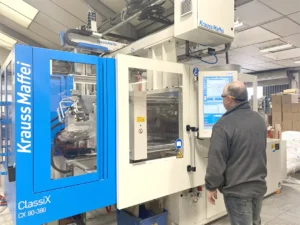
Today’s injection moulding industry looks vastly different from its origins in the 19th century. Modern machines are fully automated, computer-controlled, and capable of producing parts with microscopic precision and repeatability.
At Roland Plastics, our state-of-the-art moulding facility in Suffolk features a range of precision injection moulding machines, supported by robotic automation and advanced quality control systems. This allows us to deliver consistent, high-quality components to customers across industries, from aerospace and defence to consumer goods and medical devices.
Material innovation continues to shape the industry. Today’s manufacturers use an array of engineering-grade polymers, bioplastics, and recycled materials to meet the growing demand for performance and sustainability.

At Roland Plastics, we work closely with clients to select the most suitable materials for their application, whether it’s high-impact ABS for industrial use, lightweight polypropylene for consumer products, or sustainable alternatives that support environmental goals.
Automation and robotics now play a central role too. Robots can extract parts, stack them, and even perform assembly and packaging tasks, which improves efficiency, accuracy, and safety on the factory floor.
Sustainability and the Future of Plastic Injection Moulding
As the world focuses on reducing environmental impact, the injection moulding industry is evolving to meet new sustainability standards.

We are investing in closed-loop production systems, energy-efficient machinery, and recyclable materials to ensure that the process remains both cost-effective and environmentally responsible.
Design for Manufacture (DFM) and Design for Sustainability (DFS) are now key principles we apply to every project, ensuring that components are optimised not only for performance and production but also for their full product lifecycle.
The future of injection moulding lies in smart technology – integrating AI, real-time data monitoring, and advanced simulation tools to further enhance precision, reduce waste, and improve predictive maintenance.
A Legacy of Innovation
From Hyatt’s first celluloid button to today’s complex, precision-engineered components, injection moulding has come a long way. hat began as a simple manual process has become a cornerstone of modern manufacturing, powering industries across the globe.
At Roland Plastics, we’re proud to continue that tradition of innovation here in the UK. With decades of experience, advanced equipment, and a commitment to sustainability, we’re helping our customers turn ideas into high-quality, manufacturable products that stand the test of time.
Why Choose Roland Plastics?
As a family-run UK plastic injection moulding specialist, Roland Plastics blends long-standing expertise with a fast, flexible way of working. We’re equipped for complex, high-volume projects, while still giving every customer and component the attention it deserves.

When you work with us, you benefit from:
✅ A skilled in-house team of engineers and moulding specialists
✅ Clear, honest updates from initial enquiry to final delivery
✅ Rapid response on quotations, tooling, sampling and production
✅ A focus on sustainable, efficient manufacturing practices
✅ Reliable, repeatable quality on every production run
Our goal is simple: to help your product succeed in the market.
Looking to turn a concept into reality? From early design input and prototypes through to full-scale plastic injection moulding, we’re here to support you at each stage.
Get in touch with our friendly team to discuss your next project.
You can also keep up to date by following us on LinkedIn.